99.9F - Concert Reviews
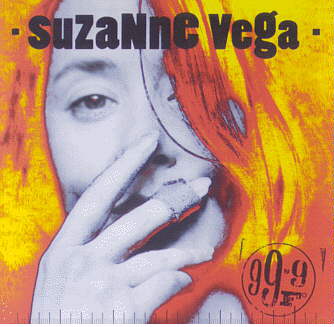
Suzanne Vega, Hammersmith Apollo
Few musical stereotypes fit as badly as the one long since assigned to Suzanne Vega. The image of fey, flaxen-haired folkie was far from apt in the first place but has become increasingly wide of the mark as, over the course of four studio albums, the 33-year-old New Yorker has subverted the expectations inherent to her genre with ever more ambitious and challenging material.
Most recently, for example, the album 99.9 Fahrenheit Degrees placed both industrial noises and dance beats alongside the expected acoustic folk to throw shadows and light on some of the most intelligent songwriting accomplished anywhere within the pop sphere during the past year. And that it has proved, in America particularly, something of a commercial disappointment seems only to have strengthened Vega's resolve to plough an individual furrow.
Vega's best work demonstrates an astonishing attention to detail: each word is weighted perfectly within any one line, each line is balanced to bring rhythm and momentum to the verse, and each verse advances the imaginatively realized narrative of the whole lyric. And that she delivers these widely divergent songs -- ``Small Blue Thing'', ``Rock in this Pocket'' and ``As Girls Go'' among them -- with a seemingly artless detachment that belies the intent behind them only intensifies their impact. But a more economically yet emotionally effective one is equally rare.
An eight-year chart career is such that she has now amassed obvious crowd-pleasers: fans ad-libbed the group DNA+s backing to her previously a cappella ``Tom+s Dinner++ in tribute to its surprise re-emergence as a 1991 dance hit and went into [a] frenzy over two beautifully delivered favorites, the hit single ``Luka++ and a closing ``The Queen and the Soldier++. Elsewhere Mitchell Froom, who produced her latest album and who here led a distinguished four-piece supporting band, ensured that a suitably robust and adventurous soundtrack accompanied her well-chosen mix of both old and new material. Despite her steely confidence, her diffidence in dealing with the clamour for another and then yet another encore suggests she still does not realise quite how good she is on present form.
Picture of Suzanne Vega singing in front of a microphone holding a guitar.
Caption: Suzanne Vega: she displays a new, steely confidence in her unhistrionic performance
Submitted by Jonathan Saunders
Suzanne Vega, The Academy, New York City, March 11th, 1993
In pop music a homecoming ought to be a happy affair. With family and riends predent, there usually exists an emotional bond between the performer and the audience that makes for wonderful give-and-take. And that's the way it was for Suzanne Vega when she returned home to New York after a seven-week tour in support of her latest album 99.9f.
Beaming and a little bit surprised by the applause showered on her when she walked onstage, Vega treated her fans to a nearly flawless set of songs about love, life and lost innocence. Taken together, they went a long way toward proving that Vega can give her best musical vignettes new breath and vitality in concert.
As expected, the lion's share of the songs Vega performsd were from the critically acclaimed 99.9F. Backed by her razor-sharp band (drummer Frank Vilardi, bassist Mike Visceglia, guitarist Mark Schulman and keyboardist Stephen Gabory), which was more interested in creating clever tonal shadings and rich, percussive filigrees than blazing solos.
Vega sent out striking renditions of new gems such as "Fat Man and Dancing Girl" and "Blood Makes Noise." During the latter song, Vega sang some of the lyrics through a small bullhorn, giving them arigid, steely edge. Yet on older songs, especially the classic "Luka," Vega opted for a warmer, more personal delivery, recalling her earlier days as an urban folkie. That Vega was able to move so effortlessly from one mode to the other revealed just how far she has come as a performer.
Of course, no Suzanne Vega concert could have been complete without a performance of "Tom's Diner." Vega saved it for the first of her three encores and let her fans help her with the now-famous chorous. They might just as well have been singing, "Welcome home, Suzanne." - Robert Santelli
Submitted by VegaNet@aol.com
Suzanne Vega, The Academy, New York City, March 11th, 1993
Suzanne Vega gained fame by sketching the view from life's corners. Her first two albums, which established her as a literate folk chanteuse in the early 1980's, offered delicate attempts to articulate the awkward and the painful. Ms. Vega's voice, prim as a china teacup, made her seem unduly coy at times, and as her career wore on, her songs became frustratingly oblique. But with her new album and a tour that stopped at the academy on Thursday night, Ms. Vega demonstrated a willingness to try new musical and thematic encounters.
Her sound first changed without her permission, when the dance group DNA remade her a cappella song, "Tom's Diner," to a loopy pop-industrial beat. Ms. Vega responded to this challenge with 99.9F," her latest album (A&M), which interlaces her voice with dance rhythms and synthesizer effects.
At the Academy, Ms. Vega and her four-piece band performed songs from throughout her career, but she focused on her developing voice as a rock artist with a folkie past. Ms. Vega has a talent for shifting the dynamics of her singing ever so slightly, increasing the intensity without sounding loud or strained.
On some of the more rock-oriented numbers, she was overwhelmed by her band's aggressiveness. But on songs dominated by Stephan Gabory's keyboards and a dance groove, she wove her vocals artfully into the mix. "Blood Makes Noise" and "As Girls Go" percolated with energy. On the new album's title track, Ms. Vega's voice became the ghost in the music's machine, diagnosing society's fear of illness with the precision of a thermometer.
Ms. Vega offered her enthusiastic fans an ample portion of her older material as well, including "Luka," "Marlene on the Wall" and a version of "Tom's Diner" in which the audience's raised voices became the backing track. But her show demonstrated how vital experimentation has proved for this once seemingly meek artist
Submitted by VegaNet@aol.com
"I don't know if I mentioned that I'm from New York City," Suzanne Vega casually announced a short way into her set at The Academy on Thursday night. The broad grin on her face and the boisterous audience response marked it as a deliberately unnecesary comment: This was the return of a hometown heroine.
Suzanne Vega's relationship to New York is usually discussed in terms of the Greeenwich Village folk scene that she emerged from in the mid-80's. But her recent, fourth album, 99.9F, with its vaguely industrial rhythms, has proven her to be so much more than a folksinger. Hence the standup venture, and the weird sonic textures, as with the metallic samples on "Rock In This Pocket." Occasionally, her group was allowed to rip like a real rock band, but more often it provided a subtle accompaniment to Vega's strong presence of voice and acoustic guitar, and now and then the band simply left it all to her - a woman, a guitar and 1,500 fans.
Variety was the show's strong suit. During "Blood Makes Noise," Vega sang through a bullhorn; encoring with "Tom's Diner," she sang a cappella, drawing the audience into providing backing for the chorus while delightfully deflecting their sloppy handclaps. While the biggest response was reserved for older material like "Small Blue Thing," "Left Of Center," and a nicely understated "Luka," there was never any suggestion that playful new songs such as "If You Were in My Movie" and "Fat Man and Dancing Girl' could not hold their own.
Apart from that plaintive but disarmingly powerful voice, Suzanne Vega's selling point has always been her ability to draw listeners into the vignettes of everyday life that she turns into exceptional songs. It was therefore no surprise that she occasionally took time out for storytelling. The moral of one rambling, and hugely funny tale, seemed to be that even from an early age, growing up in New York, Vega had been both cerebral and streetwise. And it's that delicate balance that keeps her established as one of the city's finest musicians.
That this was to be no night for folk music stereotypes was indicated early on by Kitchens of Distinction, a British three-piece who provided solid walls of richly textured rock music, over which singer Patrick Fitzgerald wove his own tales, mostly about gay love. Introducing a song from the band's first album, "Love Is Hell," he announced that "It's not happy, it's not cheery, it's not much fun - but we like it."
Fortunately for him, so did the audience.
Tony Fletcher is a free-lance writer
Submitted by VegaNet@aol.com
The fact that this concert is now planned as an annual event is a sharp reminder that human rights violations can never be written ou of the political agenda. It also emphasizes how much rock stars are now looked upon as perpetual torch-bearers for the world's good causes.
Suzanne Vega appeared after an address by Amnesty's secretary-general, Pierre Sane. Armed only with acoustic guitar, she filled the hall with her compelling introspections. Her most recent album, 99.9F, recast her in a tougher rock setting. But here, alone with just six strings, she defeated her natural stage timidity to draw an entranced audience into such well-chosen pieces as "Tired of Sleeping," "Men In A War," and her 1985 debut album's "Small Blue Thing."
But it was her opening song, "Rock In This Pocket," that best echoed the evening's mood. "I'm really well
acquainted with the span of your brow," she sang. "And if you didn't know me then, you'll know me now." As a
call from David to the Goliath of intolerance and cruelty, it was an eloquent request for amnesty - Paul Sexton
Submitted by VegaNet@aol.com