Days Of Open Hand - Album Reviews
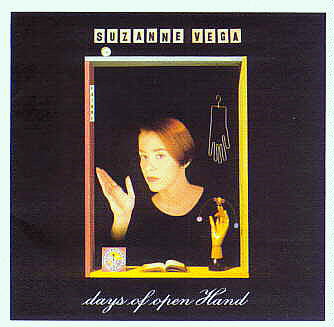
Suzanne Vega's Days of Open Hand is so guarded, so private, and so close to the chest that loudspeaker play seems an invasion of privacy. This is definite headphone music. It roots and flourishes best when is is somewhere inside your head, with no one and nothing else to invade the space.
It's not that Vega has become more personal than past efforts - dazzling glimmers of self-disclosure sparked even her first release in tracks like "Small Blue Thing." It's just that here the revelations are at once more subtle and more vast. And the dreamier, eerier images hold more impact when floating between your ears than when bouncing off the empty corners of your room.
"Rusted Pipe" describes the first sputters of a long, dark secret revealed. "Predictions" lists mystic ways of telling the future while pointing to the delicacy and fear of our existence in the moment. As in Vega's best work, the images here are both beautiful and ominous, like some darker side of ourselves. "Tired of Sleeping" is the groggy complaint of a small girl, perhaps Vega herself, trapped in a dreamland.
The production also is murkier and more darkly subtle. Vega and significant other/keyboardist Anton Sanko pull away from some of the pop leanings of her 1987 release Solitude Standing, easing off on the backbeat and tossing in rich Fairlight sounds and countless hidden samples. Still, the sonics are as vast and intricate as the material, with mixes and arrangements that envelop the listener. Unusual approaches include the Philip Glass string arrangement on "Fifty-Fifty Chance" and the bouzouki solos that garnish "Big Space."
Vega's music here, some co-written by Sanko, lacks the pop hooks that pulled a song about child abuse onto Top 40 radio ("Luka"). This time, the melodies are more confined, more repetitive, almost minimalistic. Those looking for accessible folk tunefulness may be frustrated, although they may find something just as powerful in its place. Vega has never had a gift for melody. Her strength has always come from her powerful poetic images and the haunting musical backdrops she provides. On this album, she runs with her strengths. "Those Whole Girls (Run in Grace)" has no more than five notes in its melody, sung in even, cool strokes. Yet it stands as one of the gems of the album for its stirring images and captivating sound.
Of course, it doesn't always work. "Institution Green" tries to find some dark poetics in the act of going to vote. While it raises some interesting contrasts on the institutional, dehumanizing aspects of democracy, it ends up sounding forced. And "Book of Dreams" pushes Vega's penchant for repetition to the limit of endurance. But overall, the music and lyrics offer a wealth of riches for those willing to look.
Days of Open Hand presents an interesting dilemma for the music industry. It contains gorgeous music, strong lyrics, and rock-solid production, but it is almost unmarketable through the usual hype-ridden channels. The privacy and quiet urgency of its messages are far too subtle for radio acceptance. Even the first single, "Book of Dreams," loses its poetic charm on the airwaves and becomes a sing-songish annoyance. Music promoters and chart moguls may be at a loss as to how to sell something with no clear-cut sound bites, only quiet, personal, artful music.
Unlike Vega's previous release, which featured at least one big pop hit (the unlikely Luka, a song about an abused childhood), this album doesn't have any likely AM radio material. The song In My Book of Dreams probably comes closest, as it's carried by a fairly catchy musical hook, but that hook is allowed to almost slip off before the end of the song.
For someone known primarily as a singer/songwriter, Suzanne Vega is the owner of a pretty slight voice. Some call it haunting, but her small, almost whispery tone barely carries in the songs of this recent album.
Nevertheless, Days of Open Hand is still a winner. The beauty is that what's lacking in her,voice is made up for in the instrumentals, especially in the extremely clever percussion arrangents.
There are all kinds of other voices speaking through, including an amazing hand-clap in Room Off the Street. There'd be a big hit in here somewhere, if her voice only matched the passion of the lyrics and the r6ovement of the beat.