Days Of Open Hand - Concert Reviews

Judging the quality of a Suzanne Vega concert is easy - if her voice prevails over everything else, it's a success.
Vega's voice, which at once confronts and flutters overhead, has been obscured since the hit "Luka" thrust her into the national spotlight three years ago, sending her on auditorium tours that impeded the intimacy with her audience which had come so easy in Manhattan coffeehouses.
Despite the fact that the evil children of "Luka" - her featureless back-up band, its inescapable amplifier feedback, a stadium light show, a fluctuating public persona weary from an extended international tour, and 1,000 or so pop-folk enthusiasts - came with Vega to the Austin Opera House Friday, her voice still resonated, strong and haunting.
Since the show was her second U.S. date after returning from Japan, and since Vega donned the garb of a Geisha doll during the Solitude Standing tour three years ago, many of her fans indicated with their attire that they expected the same; instead, Vega, obviously separating the songs from their source of strength, emerged as the epitome of Austin fashion, in a sleeveless heather sweatshirt and faded jeans.
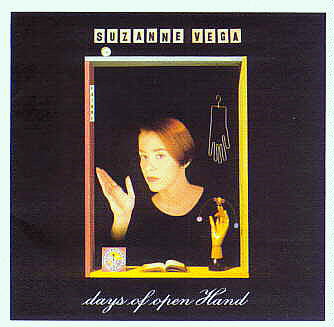
With that visual distraction thwarted, Vega proceeded to dismiss any audio ones with powerful renditions of "Rusted Pipe" and "Tired of Sleeping," from her unheralded current album Days of Open Hand.
On the album, the dominant synthesizer of Anton Sanko fills in the fluctuations of Vega's vocals, but at the show Sanko's keyboard and the rest of Vega's band were relegated to the background early and gradually yielded to Vega's solo songs.
After strong but still obligatory renditions of "Ironbound/ Fancy Poultry" and "Marlene on the Wall" the band encircled Vega and then left the stage entirely.
With no band and no image in her way, Vega wove her voice and acoustic guitar into a beautiful version of "Gypsy" from Solitude Standing. She then betrayed her reputation of solemn introspection with a sharp sense of humor - after imploring the Austin audience to follow her to Dallas for her Saturday show at the Arcadia Theater, she related several anecdotes from her elementary school days, finishing with a cheerful a cappella rendition of her playground favorite "The Willabee Song."
Unfortunately, the band interrupted Vega's monologue by returning to the stage and cluttering another round of inevitable songs like "Luka" and "Book of Dreams." Vega's return to solitude, however, resulted in another series of intimate songs, none more mesmerizing than her first encore of "The Queen and the Soldier" from her 1985 self-titled debut and "Tom's Diner," whose blend of Vega's voice and the unisoned snaps of 2,000 hands produced the concert's most beautiful song.
The rapture of the Opera House crowd was not measured by the number of Bic lighters held aloft or the duration of the applause, but by the fans' tacit struggle all night not to compete with her voice. And with their help, Vega reasserted her uniqueness, which defies the traditional categories used to format radio airplays and target audiences. It's a defiance that at once stunts her potential for star status and preserves the climate needed to maintain her integrity as an artist.
[Photo of Suzanne at the microphone]
[Caption: "Suzanne Vega mixed hits with ambiance at her Friday night
concert."]
Suzzzzzzanne Vegaaahhhhhh
Sweetness lasts just a couple of songs with Suzanne Vega. However, yesterdays concert in Groningen - presented as the only one in the Netherlands, although a previous one was in The Hague last May- lasted more than one and a half hours and twenty songs.
Debut
At her debut as a girl with guitar in New York folkclubs like The Speakeasy and Folk City she was praised by critics and compared to Joni Mitchell and Bob Dylan. As a result of this success she released her first album, plainly self-titled in making her "a phenomenon". "Her second album, Solitude Standing, made her a star. With her third album Days Of Open Hand, Suzanne Vega develops into one of the clearest, purest, most poetic voices of the nineties."
That is, thus is acclaimed in her own tourbook, delivered with the Tour of Open Hand. It does not only sound pretentious, it is plain exagerated. Especially when one sees Suzanne.
I do not want to speak any evil about her, because she is such a sweet and fragile girl. With a little voice which can be just as moving as kid's, repeatedly reaching for the right key and everytime just missing it. Like a little Sinaspril-kid who cites the song it learned in kindergarten, all by itself in a crowded living room. Meanwhile counting every loop in the high wool carpet and nervously drilling her pointing finger into the buttonhole of her vest. It almost makes grandma snivel.
Just like I felt yesterday hearing Suzanne sing a song, she learned as an eight year old. A folk song, she said, because it was sung at school in the past by black as well as Puerto Rican, by Asian as well as thin, pale kids. How folk can it be? It was not called 'Kumbayah', nor 'I'm working on the railroad'. What it was called Suzanne did not say either. When she was eight, she could not have done it any better.
Poor Thing
It sounded like Tom's Diner, the encore in which the poor thing forgot the lyrics. But those lyrics then are much more difficult to remember. And that basically tells what Suzanne Vega is: She is a fine observer. She has the gift to draw spheres and pictures in between the narrow space a songtexts offers to lines and words. From Room Off The Street: Somewhere in a room is a woman who's drinking and her dress is so tight, you can see every breath that she takes. Do you get it? A simple example, but you immediately know what it looks like.
Thus she reveals the beauty of simplicity, sometimes with a couple of lines consisting of just one word This with the intention to wake up the lower consciousness of man by the recognizability of it all. Only does Suzanne not have a rough throat, but a sweet one. And then even two stools on a stage offer to little variation. I would rather prefer a bed.
Translated and Submitted by Huub Ritzema
VegaNet@aol.com