
|
Brian Rose's Travel Journal
- 1990 -
|
|
Brian Rose's Travel Journal
- 1990 -
The following are excerpts from my journal made during that trip.
In the nine months since I was last in Germany, the DDR, or East Germany, has been swallowed up willingly by West Germany. This dramatic event occurred quicker than most people expected--thanks in no small part to Gorbachev's acquiescence. Voices of doubt and anguish were heard, but the deed was done, and done with only a modest amount of nationalistic hoopla. There is but one Germany today.
There is also only one Berlin now, and my task on this trip will be to acknowledge that fact by photographing along what once was the Berlin wall. How much of the wall is still standing I don't know. Perhaps there are still some ruined sections of it. Undoubtedly, the cleared strip that used to lie between the parallel walls remains, although the city is sure to fill into these long abandoned areas in the near future.
Was jet-lagged all day yesterday. Napped and walked around with Renee. Saw her old apartment in a beautiful neighborhood near the Vondelpark and the museums. We are actually staying in an apartment in the Jordaan lent by a friend (Renee is in the process of moving to a new place) that is in a rather run-down building with a precariously steep stairway. The bedroom is in a garret above the main floor of the apartment and is reached by a ladder. An art gallery on the ground floor is patronized by a steady stream of men who stay for a few minutes and leave without apparently puchasing any paintings.
I am now more than halfway to Berlin on the train passing through Braunschweig. This will be my first crossing of the former borderline since it was erased by the reunion of Germany. We crossed the old border just west of Helmstedt, a name synonomous in my mind with the border. It was previosly a major autobahn and rail crossing into East Germany. The concrete fence poles of the border were still there. but the metal fencing material itself had been removed. A guard tower lay on its side, broken along the seams of its precast concrete segments. Despite all the changes of the last year, the trip across the East still gave me the sense of crossing a dark and forbidden zone. Berlin still seems like a brightly colored bauble in a sea of murky water.
The next day I went to Checkpoint Charlie past the wall museum, which is still doing a brisk business. At the former border crossing itself, numerous displays of Russian and East German uniforms, pins, insignias, and other paraphernalia were for sale. The large customs shed built a few years ago by the East Germans was still there, but nothing impeded the traffic passing through. The no man's land that used to lie between the walls is still just a swath of cleared land, muddy and desolate. The narrow roadway that was once used by the East German guard vehicles now makes for a convenient path, and a steady stream of bicycles passed by. (Image of no man's land)
I then walked to the Brandenburg Gate, which is under renovation, and down Unter den Linden to the Freidrichstrasse Bahnhof, once the location of the main crossing point into and out of East Berlin. The large glass building used for customs, with its tiny mirrored compartments where westerners were scrutinized by blank-faced Vopos (Volkspolizei) before being allowed in or out of the DDR, was empty. I walked by the U.S. consulate, still there with its kitschy scenes of American life in glass cases out in front. I took the S-Bahn to Prenzlauerberg to the street where Anamarie Michnevich (my friend from New York now in Berlin) is living. I found the building, crumbling, like so many East Berlin buildings, and walked through the dark hinterhof, or courtyard, and up the stairs to her door. She wasn't home, so I left a note on a pad of paper hanging on the door. I hadn't called ahead because she has no phone--still a scarce service in East Berlin.
Anamarie came by last night, and I drove with her to her apartment in Prenzlauerberg. There are two rooms in the apartment--quite large--and a kitchen. The windows face southwest and look out toward Alexanderplatz and the back-to-the-future TV tower that looms over everything in Berlin Mitte. Coal stoves heat the two rooms and reqire occasional stoking.
Originally, Anamarie had squatted the apartment. She had gone door to door in the neighborhood asking about vacancies, and apparently some of the tenants encouraged her to just move in. In other part of East Berlin, militant squatters groups have taken over buildings and parts of whole blocks. The other night the police were sent to a street in Friedrichshain, and hundreds of squatters were rousted. Dozens were arrested and both police and squatters were injured. Weapons and bricks were found in some of the apartments.
I returned from Anamarie's place in a taxi driven by an East Berliner who didn't know how to get to the Kurfuerstendamm in West Berlin. I had to help him find his way. We talked the whole way, which was most difficult for me with my meager German. He is an admirer of George Bush.
I walked to Treptower Park, the location of the Soviet war memorial and burial place for
thousands of Russians killed in the final push to take Berlin. The memorial is an enormous
monumental garden culminating in a statue of a war hero holding a sword. The statue is,
perhaps, 20 feet tall and stands on a pedestal at least as high. Along the side aisles of the
vast ceremonial space beneath the statue are bas-reliefs depicting the heroic deeds of he
Soviet army, and tell the story of the liberation of the German people from the Nazis--the
standard absolution of guilt awarded to the East Germans by their communist captors.
Carved into the sides of these sculptural elements are quotes from Joseph Stalin. The
stone used in the memorial was taken from the ruins of the Reich Chancellery. 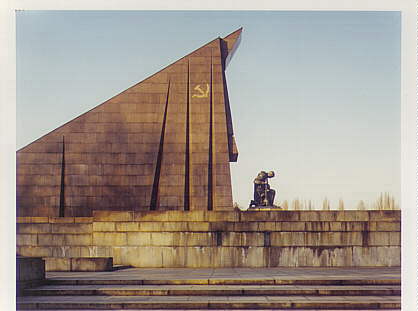 (Image of memorial)
This morning there is a little sun outside--the first I've seen in a week. The house where I am staying is slowly waking up. A friend of the person I am staying with arrived last night from Hamburg to take part in today's demonstration against the police actions to evict squatters from East Berlin buildings. I have mixed feelings about the situation. I fear there will be violence from some of the protesters, and the Berlin police have not shown admirable restraint in the past. The squatters are comprised of an assortment of political radicals mostly from the left, but they are sometimes pitted against right wing skinhead groups. These people have been active in Berlin for years, but the removal of the wall, rather than detracting from the counter-cultural appeal of Berlin, has given it new impetus.
That evening I found Anamarie sanding the floors of her apartment. She was covered head to toe in dust, but she made some coffee, and then gave me a lift to the Palast Hotel opposite Marx-Engels Forum where Suzanne Vega is staying while in Berlin. I ran into two of her band members in the lobby and then met Allen, her tour manager, who told me that they had just arrived a couple of hours earlier. Outside in the street, fleets of police cars and vans cruised by, presumably to head off the protesters somewhere over in West Berlin. Suzanne came down to the lobby and we went for dinner at an excellent restaurant near the Ku'damm. The restaurant was patronized by a rather theatrical looking crowd. Each group arriving would push aside the front door curtains, strike a pose, greet the maitre d', and glide to their tables. We enjoyed the food and were immensely entertained by the comings and goings of the guests, particularly one woman wearing a skin-tight green jump suit.
According to today's paper: Yesterday, a Russian soldier stationed in Potsdam commandeered a tank and drove it into West Berlin down the Ku'damm. He damaged several cars in the process and was pursued by numerous police and Russian military vehicles. He was finally stopped when one of his pursuers jumped on the tank and threw a coat over the driver's opening, which prevented him from seeing. Apparently, an argument between the soldier and his girlfriend had precipitated the escapade.
I met Suzanne at a press conference she was doing at the Cafe Einstein. The cafe, which occupies several rooms of what was once a large villa on the Kurfuerstenstrasse, had been rented for the morning and was filled with fifty or more journalists and photographers. Suzanne walked in, posed for almost five minutes for the photographers, and took a seat behind a long table set before French doors that looked out on a garden. The questions were generally not very interesting. Suzanne dodged a few political questions--some specifically about the late-breaking squatter/police activities--and a few awkward questions about a death threat that had been recently directed toward her bass player while they were in England. (Suzanne performed in a bullet-proof vest at one outdoor concert.) That event, or non-event, has been blown out of proportion. After the conference Suzanne did an on-camera interview with an Italian TV crew that is following her around for a few days.
From there we battled post-wall Berlin traffic, crossing the no man's land a couple of times before finally stopping at a stretch of still-standing wall painted on by various artists. We got out of our car and Suzanne, Anton, and I walked along the wall in a blinding drizzle for the Italian camera crew. Back in the car we returned to the Palast Hotel for a short rest, and then we boarded the tour bus and made our way through East Berlin to the hall where Suzanne was scheduled to play that evening. It was a sports hall built around 1950. Backstage was a book signed by various ice hockey teams, participants of political song gatherings--including Pete Seeger--and more recently, a few rock acts including James Brown and Grace Jones. Many of the earlier signers had wished success to the East German communist state and to Erich Honecker in particular.
As show time neared it became obvious that a very large crowd would be on hand for the concert. In the end it was 7,500 people and we were told that 1,500 had been turned away. The crowd was tremendously enthusiastic and Suzanne and the band put on one of the best shows I've seen them do. Afterwards, Suzanne was elated--Anton moped because he had had equipment problems--Mike and Frank argued about Frank's impromptu drum excursion at the end of "Casper Hauser"--and Marc seemed pretty happy about the whole thing.
I bought a train ticket for Prague where I will be meeting up again with Suzanne's tour. She has gone to Minden in West Germany for a concert, but I stayed in Berlin. Near the station I bought a copy of Jane Kramer's "Europeans," and I also picked up a paperback copy of Rene Burri's "Die Deutschen," a photo book I've admired but had only seen before in expensive hard cover. I then took a taxi to the Philharmonie and bought a ticket for a concert that I plan to attend with Anamarie when I get back from Prague. It's the Berlin Philharmonic conducted by Seiji Ozawa with Mstislav Rostropovich on cello performing three concertos including one by Alfred Schnittke, a contemporary Russian composer I've been interested in for a while.
I took a taxi to the Lichtenberg Bahnhof, a rather remote station in East Berlin where the trains leave for various southern destinations. Before reunification it must have been quite a trek to the station, clearing customs at Friedrichstrasse and then taking the S-Bahn to Lichtenberg--though it's doubtful that many westerners would have gone that way. Even now with the wall down it is somewhat forbidding to pass through the dark streets of East Berlin to reach this small dingy train station.
There didn't appear to be too many westerners travelling now. A woman sat in my compartment on the train, but as soon as she realized I was a foreigner, she wordlessly got up and left. At Dresden I caught a glimpse of the old center of the city ravaged by the bombing and resulting firestorm during World War II. I could see the opera house and church spires as my train crossed the Elbe River. As we pulled into the station, hundreds of people began running and jostling one another for advantage in boarding the train. Old women with plastic shopping bags and scruffy looking men pressed forward as the train came to a stop.
Eight of us were now packed into one compartment. Almost immediately an argument broke out because a young man in front of me would not take the seat closest to the window to allow a couple to sit together. Someone else shifted to that seat, finally. Throughout the rest of the trip, the compartment was filled with constant chatter in Czech--or Slovak--usually in loud argumentative tones. The hall outside was filled with standees, and people were constantly getting up and sitting back down. One man in particular was unpleasant. There was some kind of problem with his ticket, and he and the conductor almost came to blows. The man sat down across from me. He had oily and scarred skin and his forearms were covered with tattoos. There were needle marks on the inside of his arms.
I did my best to pull within my shell as I pressed up against the train window. Outside, the despoiled Czech landscape slipped by. Factories and fields co-mingled in a chaotic and disturbing patchwork. High on the hillsides, pre-fab concrete housing blocks were stacked randomly. Pipes carrying oil or chemicals were elevated over the fields, and everywhere coal smoke poured from chimneys and smokestacks.
In Prague, I mistakenly (or so I thought at the time) got off the train at a suburban station and had to walk into the city. There was nowhere in the station to exchange money, and I was unaware of a subway line that would have quickly taken me to the center of town. I got confused and started walking in the wrong direction. A group of teenage boys were walking down the street, and I heard them singing a familiar tune--dut dut duh dut--it was Suzanne's song "Tom's Diner" (!). Eventually I saw the spires of central Prague--which had been hidden behind the hills--and found my way to the main square.
I stood in the midst of hundreds--maybe thousands--of people and began to strategize how I might find out which hotel Suzanne was staying in. I had stupidly neglected to write the name down. Amazingly, a voice called out--hey Brian! It was Mike, Suzanne's bass player. He was touring the square with the other band members. They told me how to find the hotel--a substantial distance away--but easy to reach by subway. The hotel was situated in the middle of a neighborhood of concrete slab housing and a few glass office buildings. The Interhotel, itself a glass skyscraper of about 20 stories, was a holdover from the communist days when tourists and business people were able to stay only at expensive state-owned, secret-police-guarded hotels.
All of this--the hotel and the landscape I had just passed through on the train--stood in profound contrast to the beauty of old Prague. Largely undamaged by the war, it gracefully wears the architectural accretions of centuries. Not only the old medievel and baroque buildings impressed me, but also the many Jugenstil and/or Art Nouveau buldings scattered outside the oldest part of the city.
Last night we--Suzanne, the band, and crew--went to dinner at a restaurant across the Vltava River beneath the Prague Castle. The restaurant was barely marked on the outside, but inside it was full of people and the atmostphere was warm and convivial. We had Prague ham served with an incongruous topping of whipped cream and horseradish. As everywhere in Prague, the prices were extremely low--which is a shock after being in Germany where the dollar does not go very far. I can only speculate how little the average person must earn here. Afterwards we walked through the city, startlingly devoid of people, our footsteps ringing in the streets. It was quite magical--and then back to our hotel tower of banality.
Yesterday it rained most of the day so none of us went into the center of town to walk around as planned. We rested in the hotel. In the lobby we ran into a white-haired man in a tweed jacket--apparently one of the concert organizers--who informed us that 4,000 tickets had been sold--1,200 more than the hall is supposed to hold. I sat in the hotel snack bar and read some of Jane Kramer's New Yorker essays collected in the book "Europeans." At four we left for the hall, which was part of a complex of buildings including another glass skyscraper hotel. The hall itself was spacious though a little bland. We later learned that it had been the meeting hall for Czech communist party gatherings, and that for concert audiences those memories are still quite fresh. It has been, of course, only a year since the so-called "velvet revolution" swept the communists out of power, and Vaclav Havel, the playwright, was elected president.
After the soundcheck we had a make-shift traditional Thanksgiving dinner prepared by the English caterers traveling with the tour. We had turkey with mashed potatoes and gravy, which was pretty good, although the fluourescent-lit room left a little to be desired. About a half hour before show time I took a peek at the audience from the stage and was horrified to see that the hall had indeed been drastically oversold. The standing room people were standing or sitting in the aisles preventing the reserved ticket holders from getting to their seats. The entrances to the hall were jammed and impassable. Eventually, things were worked out, though 1,200 (!) people had to find standing space in the hall.
As in East Berlin, the crowd was expectant and enthusiastic. Rarely in the States have I seen this kind of response to Suzanne's music. Part of it I attribute to the newness of this kind of pop concert in countries closed to the West for so many decades. But largely, I think, the audiences were responding because the songs meant something to them. In Czechoslovakia, in particular, music played an important role in the revolution--in keeping alive hope and providing some means of expression against the state. It was an emotional evening for me, as it had been in Berlin. The show ended with an especially effective drum solo by Frank in "Casper Hauser," a song that seemed to take on added significance in these eastern countries. "I fell under a moving piece of sun, freedom." In these moments I could almost forget the profound difficulties that are faced all over eastern Europe--and particulary by these brightly alive faces--the cream of Czechoslovak society--who must rebuild their country.
After the show Suzanne faced the press in a brief and chaotic gathering backstage. Suzanne was somewhat intimidated by the crowd of journalists and was not at her best in answering questions. She was also exhausted. Later she kept saying how there were so many things she would like to have said, but couldn't come up with them in the crush of journalists and flashing cameras.
Back at the hotel we wound down with a few drinks and watched the blatant prostitution going on in the bar. About a dozen provocatively dressed women worked the crowd of businessmen, going upstairs and returning shortly to pick up another customer. Today the tour moves onto Vienna, and I return to Berlin.
I walked around Prague all day on Friday. I crossed the Charles Bridge and walked through the old Jewish cemetery with its layers and layers of graves and hundreds of gravestones tilting every-which-way. I also attempted to spend my Czech money on either books or records, but I had a hard time finding much that I really wanted. Suzanne's albums were supposed to have been available in Prague, but I didn't see any. All the stores seemed to have exactly the same books or records, and I assume they are still state-owned. Were there private shops that sold western records? I finally bought three CDs of Czech Philharmonic recordings for $4 a piece.
My train returned to the same remote station in East Berlin I had left from. Anamarie had said she might pick me up there, but she was nowhere in sight. The station was crawling with sinister types--drunks and skinheads--and the floor was littered with the bundled forms of homeless people. I retreated back upstairs to the train platform and caught the next S-Bahn to the Zoo Station in West Berlin.
On Monday I awoke to steady rain and decided to go the Zoo Bahnhof to buy my train ticket back to Amsterdam a couple of days ahead of time. Signs on the doors stated that the Deutsche Reichsbahn, the ex-DDR railroad, which still runs all the trains in and out of Berlin, was on strike. After talking to someone in a travel agency, who said there was no way of knowing how long the strike might last, I booked a flight from Berlin to Hannover with a train connection to Amsterdam.
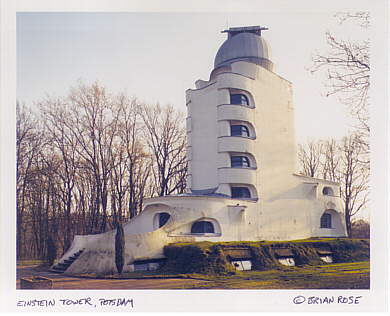
Saturday morning I went by car with Anamarie and three friends of hers to see the Einstein Tower by the expressionist architect Erich Mendelsohn. The tower, a solar observatory, is located near Potsdam on the outskirts of Berlin. It was built around 1920. Before the wall came down, the Einstein Tower was quite difficult to get to, and few foreigners have seen it in many years. The tour was led by a bearded scientist who spoke clear and precise German --not that I could follow all of it--and his sidekick fed slides into an old-fashioned projector one by one.
After 30 minutes or so of this science background we were led to the tower, which stands on
a grassy plateau surrounded by a grove of trees. The tower is remarkable to see--even today
it is a radical design with its undulating surfaces and expressionistic lines. An office on the
ground floor contains the original furniture designed by Mendelsohn frozen in time.
 (Image of Einstein Tower)
The next day I set out on foot for the Lenin memorial on Lenin Platz, not far from Anamarie's apartment. It's in the part of East Berlin that was cleared in the 50s to make way for dozens of concrete housing blocks. The memorial is a large statue of Lenin done in the familiar heavy-handed Soviet style, and the figure is posed in front of an immense apartment tower. I walked to to Karl Marx Allee and looked at the huge Stalinesque apartment buildings built just after the war that line the boulevard. They look more like Moscow than Berlin, but despite their pretentiousness, they have more character than the newer apartment projects nearby.
Walking on further, I reached the section of wall where Suzanne and I walked in the rain for Italian television about a week ago. Workmen were removing a guard tower nearby, and a toppled one I had seen earlier was no longer there. Everything is vanishing almost before my eyes. I walked on and passed another guard tower still standing--the one that Hans Haacke, a former art teacher of mine, had festooned with a glowing neon Mercedes-Benz star. Dismantled now. A great Haacke piece I think. An old man walking his dog looked at me with my camera and wondered aloud why I was taking photographs when the wall isn't there any more.
Behind the Axel Springer publishing building on some buildings across the no man,s land were various advertising billboards. One was a cigarette ad saying "Come Together" with a white and black persons' smiling faces. Next to that was a political poster for the PDS, the successor to the SED, the old communist party of East Germany. In the ad, a sassy, very modern young woman sticks her tongue out in joyful exuberance. The slogan says "Left is Lively." To the left of the billboards, grafitti on the wall reads "Keine Stasi Amnesty" (no amnesty for the Stasi, the former secret police)--once controlled, of course, by the SED--now transformed into the joie de vivre PDS.
Later that day I visited a friend who owns an art gallery in West Berlin. We had an enjoyable chat about Berlin and the changes that have taken place. Like many Berliners he misses the old wall days, though he would never suggest that the events of the last year should not have have happened. He is concerned about the influx of eastern Europeans into Berlin, and it is expected that Russians will no longer have to acquire special visas to leave the Soviet Union. This could result in even more disaffected and unsophisticated people--peasants and factory workers--pouring into Berlin. Yesterday, I saw a man in the street carrying a whole skinned goat over his shoulder.
This morning I flew from Berlin to Hannover and took the train to Amsterdam. The Reichsbahn strike is partially over according to the Herald Tribune, but I was glad to be out of Berlin without once again entrusting my fate to the collapsing East German infrastructure.
On Friday in Amsterdam, Renee and I went to see an exhibit of eastern European photography at the old stock exchange building on the Damrak--the Beurs van Berlage. The building is named for it designer, the great dutch architect H.P. Berlage.
The exhibit was quite fascinating. Most of the photographs dealt with recent events in eastern Europe, or with the lives of ordinary people in these countries over the past few decades. Most of the photographers worked in a reportage style, which tended to emphasize the bleakness of places and the poignancy of people's lives. Repeatedly, tormented eyes stared out from gritty black and white prints. The best work, not surprisingly, was Joseph Koudelka's images of Prague Spring 1968, many of which I have seen before.
On Saturday I failed miserably to leave Europe. I was late to the train station in Amsterdam, and when the next train to airport was cancelled due to mechanical problems, I was stuck with having to make a hopeless journey to the airport knowing I wouldn't make my flight. At the airport I bought a ticket for the next day--after paying a substantial penalty--and then I somehow managed to lose my address book while trying to call Renee. I took a cab back to Renee's apartment and waited forlornly on the street about an hour until she came home. She was laden with shopping bags full of clothes bought in the few hours since my apparent departure. Today I have been more successful in tearing myself away from the continent, and I look forward to processing my film and making prints.
Website by Eric Szczerbinski - EricS10332@aol.com