




|
Suzanne Vega's Paris Video Interview
[courtesy A&M Records]
|
Could you tell us about your new album "Nine Objects of Desire?"
Suzanne:
The album is called, "Nine Objects of Desire", and there are twelve songs in the album, and the reason for that is that there are some objects of desire that come around twice on the album. There are two songs to my husband and two songs to my daughter, and two songs for the figure of death. And then there are six other objects of desire that the songs are written to.
|
|||||
|
How did you decide to explore the different sounds and rhythms found on "Nine Objects Of Desire?" Suzanne: Well, for some reason this time it felt very natural to use the Latin rhythms that I grew up with. You know, I think for a long time I was suppressing them and trying not to have them come out of the music. And this time in my life it felt very natural and the record, to me, has a more seductive feeling and a more sensual quality than some of the other records do.
|
|||||
How did you and producer Mitchell Froom incorporate your affinity for Latin rhythms in the recording of your album? Suzanne: Well, there was one song called "Lolita", where Mitchell had the rhythm already and had most of the music already, and I had had most of the words already. We were attempting to do something like the band called War, which was kind of an L.A. band, but it was very popular in New York also when I was growing up, and it had a very Latin sound and a very street Latin sound; kind of a mixture of American and Latin. So it felt very natural for me to sing that song over that kind of rhythm. But we were attempting to do something like War or like Santana, because then they were both groups that I had listened to.
|
|||||
You explore different musical styles on the new album. Which styles influenced your approach? Suzanne: Yes, the usual. The usual mixture of rock and roll and folk and jazz and Latin. And not only that, but different generations, too. There were some old-fashioned things; things maybe from the Fifties, like Julie London. I listened to her singing a lot; a song like "Caramel,, or something maybe that Astrud Gilberto could have sung in the Sixties. So we were also stealing from the different decades the Sixties and the Seventies and the Fifties and the Forties even some, with the horn arrangements. So we steal from everywhere.
|
|||||
There are references to various locations on the new album. Are you still based in New York City? Suzanne: This album might have a broader perspective, might have more of a world perspective. Because I find, first of all, I live in New York, as I always have. My husband lives in Los Angeles, which didn't seem like a problem at the time. It seemed like well, we love each other, we'll get married, not a problem. But I find I'm not at home as often as I used to be, so I spend time in Los Angeles, I spend time here in Europe, I spend time traveling so that we can be together as a family. And so I don't spend time in Tom's Diner any more, as much as I used to, or walking the same streets. But I always return there because I feel that I need to and I really love it there. And I feel it does help my writing to go back.
|
|||||
How do you feel about the increasing number of female artists on the scene today? Suzanne: I think that the way the music is now, with a lot of women performing -- and a lot of men are still performing -- I think the way it is now is more healthy than it was before. It's more natural. I think it's more natural to have a lot of women with very different characters and different kinds of music, and different personalities, and in some ways it makes it easier for me because then I can just be free to be myself and do what I do well, and be myself, instead of trying to be everything to everybody. So I listen to a lot of the women who are coming up and I evaluate them and I say oh, I like this one, I don't like that one. And I don't talk about it in public, because then they would print it and make a big thing out of it, but I'm interested and I feel that my music is still very current and I feel part of the same scene, in a sense. But I also know that I've been doing it a very long time and that I feel I have my own distinct voice.
|
|||||
|
You recently recorded and performed with John Cale. Do you enjoy working with other artists?
Suzanne:
It was a lot of fun to do that "Songs from the Cold Seas" project with John Cale. I didn't realize John Cale was going to be on it until after it was all finished, because I went to the studio and read the poem, and then they produced everything afterwards. And I got to perform with John Cale at the Bottom Line and I love him. I love his voice and it was very exciting to be able to work with him. So I like to work and I try and work as often as I can.
|
|||||
Do you work too much? Suzanne: Do I work too much? I don't think anyone would think I work too much, but I like it, you know, so I do it as often as I can. Still takes four years in between records, but, you know, I still try and work as much as I can.
|
|||||
|
You wrote songs for your daughter and husband on "Nine objects Of Desire.,, How did they react?
Suzanne: No. Yes, I wrote two songs for my daughter and I wrote two songs for my husband. But when I write the song I'm not writing it for their approval or for their affection, you know; my husband, I think, was slightly embarrassed about the song about the honeymoon suite. You know, it was meant to be kind of funny and I think he got used to it, you know, but in the beginning it made him slightly embarrassed. And my daughter doesn't, you know, care about the song that I wrote for her. She likes some of the other songs. And in the end, I don't think it really matters. I'm not going to hold the song to her and say see, I wrote this song for you and you have to appreciate me because of this. You know, I hope she does, but if she doesn't that's the nature of a child, you know. It takes them a while to appreciate things.
|
|||||
|
Are you concerned about bringing up your daughter in today's world?
Suzanne: Yes, I think a lot about the world that we live in today and the world that she's going to grow up in. I really hope that I can shield her from suffering. I think there are a lot of good things in the world today. I think that people are becoming more aware of the need to preserve the world and the natural world, and I think people are more aware of the fact that we have to respect one another as human beings. And I think that groups like Amnesty International are very important because they keep reminding us that we have to respect one another as human beings, and that there's nothing more basic than that. And so that gives me hope, you know. So I think you have to have courage and continue forward, even if you feel that there are terrible things ;:hat happen in the world.
|
|||||
|
|
~ end ~ | ||||
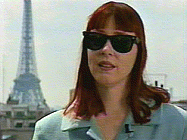

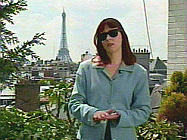

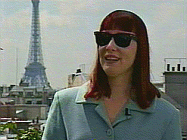
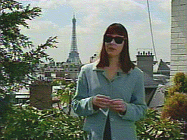
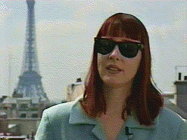
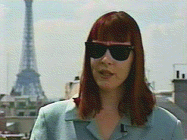

Audio clips, video clips and video stills by Neil Impelluso
Please send your comments, suggestions, submissions to:
VegaNet.
 Up to The Suzanne Vega Home Page
VegaNet@aol.com