Suzanne Vega - Album Reviews
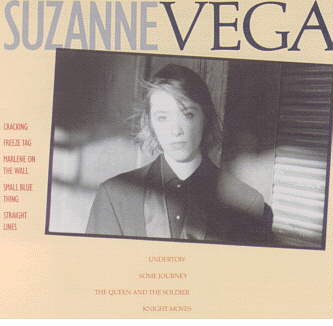
It wasn't until the release of her second album that Suzanne Vega achieved fame, scoring an unlikely Top Forty hit with "Luka," a song about child abuse. But the singer's 1985 album Suzanne Vega, had already awakened listeners to a fresh new voice, reviving the folk-music genre after nearly two decades of dormancy. For Vega, who was then twenty-five years old, the album was cause for uncertainty and isolation as much as triumph. "I felt a little bit like a novelty act," she says of her auspicious introduction.
Vega was certainly an anomaly during the mid-Eighties, softly strumming an acoustic guitar and singing introspective ballads while the rest of the music world was caught in bigger-is-better events like Live Aid and Brice Springsteen's Born in the U.S.A. mega-tour. In retrospect, however, Vega's intimate first album proved to be a significant milestone in this decade, ushering in a flock of female folk singers, including Tracy Chapman, Melissa Etheridge, Michelle Shocked, Tanita Tikaram and the Indigo Girls.
Having taught herself guitar at the age of eleven, Vega began writing her own songs when she entered her teens. After graduating from Barnard College in 1982, she began playing small coffeehouses in Greenwich Village - the same area of New York City where nearly every Sixties folkie first tuned up his Gibson. But Vega, a child of the Eighties, hardly fit the protest-singer mold. Even though she carried an acoustic guitar, her hero wasn't folk icon Bob Dylan but punk godfather Lou Reed. There are other differences as well. After years on the Northeastern club circuit, she had developed a direct, emotionally tempered style that she has said was inspired as much by novelist Carson McCullers and painter Edward Hopper as by romantic balladeers Leonard Cohen and Laura Nyro.
Weaving these diverse influences into a deeply moving album were producers Lenny Kaye (formerly Patti Smith's guitarist) and Steve Addabbo (Vega's manager), who brought modern touches to Vega's straight-ahead style, enhancing the singer's sparse sound with subtle electric guitars, graceful violons and even New Age synthesizers, all of which added gentle textures to her haunting material.
Vega's prowess with simile and metaphor dominates the entire album, perhaps most effectively on songs like "Undertow," "Freeze Tag," and "Straight Lines." But Vega's sphinxlike wordplay reaches its apex on "Small Blue Thing," a ballad more reflective of an intangible feeling than a literal object. "The song is actually pretty straightforward - it's not a riddle," she says with a laugh. "I never try and be tricky. At the time, I felt like a small blue thing. I never expected that people would think that it stood for something. Some people even asked if ti's a fetus. It's not that at all - it's a mood.
"The structures behind folk music are very elemental, sort of like water," Vega adds. "You go through your fads with wine and soft drinks and everything else, but water is the basic thing you always go back to."
Producers: Lenny Kaye and Steve Addabbo. Executive Producer: Ronakd K. Fierstein. Released: April 1985. Highest Chart Position: Number Ninety-One
(The review also appears in the "Suzanne Vega" Album Review section.
Suzanne Vega
Suzanne Vega
Producers : Lenny Kaye and
Steve Addabbo
Engineer: Steve Addabbo
A&M SP6-5072
Released: 1985
Total Disc Time: 35:26
Source - LP
Performance: 10
Sound Quality: 9
TRACKS:
Cracking
Freeze Tag
Marlene on the Wall
Small Blue Thing
Straight Lines
Undertow
Some Journey
The Queen and the Soldier
Knight Moves
Neighborhood Girls
Solitude Standing
Suzanne Vega
Producers : Lenny Kaye, Steve Addabbo & Mitch Easter
Engineers: Steve Addabbo and Rod O'Brien
A&M CD 5136
Released: 1987
Total Disc Time: 44:25
Source - Compact Disc
Performance: 9
Sound Quality: 9
SPARS Code: AAD
TRACKS:
Tom's Diner
Luka
Ironbound/Fancy Poultry
In the Eye
Night Vision
Solitude Standing
Calypso
Language
Gypsy
Wooden Horse (Caspar Hauser's Song)
Tom's Diner (Reprise)
Suzanne Vega's strengths lie in her ability to write subtle, catchy lyrics and music while packing the wallop of a mule kick along with them. At first listen Vega's tunes sound pleasant, enjoyable and catchy. And unless you listen closely you'll never notice that these bright, bouncy tunes have a complexity that matches their bounciness. She writes of Death and Freedom in 'Undertow' from her 1985 debut LP, of child abuse in 'Luka' from her recently released album "Solitude Standing", of heartbreak in 'Cracking' also from her 1985 record, and a 17 year old boy who was shut away in a basement since infancy in 'Wooden Horse (Caspar Hauser's Song)' from "Solitude Standing."
And her lyrics have a quality of jumping out at you, especially after listening to her songs more than once. Lyrics are provided with both her 1985 self-titled release and 1987's "Solitude Standing." And it's a good thing that lyric sheets are included because Vega's writing demands to be read as well as heard. Her voiced images are reinforced by the written word; her music emphasises her voice and your reading. In 'Undertow' she writes "I would leave only bones and teeth/We could see what was underneath/And you would be free then, free then" equating death and freedom in the same breath. In 'Cracking' "It's a one time thing/It just happens/a lot/Walk with me/And we will see/what we have got" and "My heart is broken/It is worn out at the knees/Hearing muffled/Seeing blind/Soon it will hit the Deep Freeze" Vega paints an image of pain and despair, yet there's also acceptance since "It just happens/a lot." In 'Luka' "If you hear something late at night/Some kind of trouble, some kind of fight/ Just don't ask me what it was" and "They only hit until you cry/And after that you don't ask why/You just don't argue anymore" are hard hitting lyrics, but you can easily gloss right over them because the beat is as infectious as the lyrics are poignant.
Vega has smarts and she has style. She has a slightly off-center view of the world that has provided us with two wonderful albums full of poetry to read AND listen to. Rolling Stone Magazine called her music 'Uneasy Listening'. In two words or less, nothing describes her music better. Her music is haunting, relaxing, shocking, subtle, blunt, melodic, hard hitting and pleasant all at the same time. Listening to and reading Suzanne Vega can shake up the old brain cells. She get it very well.
Both her 1985 LP and the CD of "Solitude Standing" have excellent sound and production. Her debut album is a little more sparse, it is mostly an acoustic album, with instrumentation than "Solitude Standing." "Solitude" has a much more noticable drum mix and the CD is virtually flawless.
From Network Audio Bits