
The Clash with the Church
|
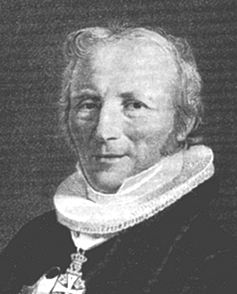
| Bishop Jakob Peter Mynster (1775-1854) |
The event which set things in train was the death of Bishop Mynster. Mynster had been Bishop of Sjælland and Primate of the Church of Denmark for twenty years. He had been a great influence on old Michael Pedersen Kierkegaard, and part- ly in deference to his father the son had continued to respect the great prelate. Mynster was, first and foremost, a man of wide culture and a man of the world. There is no reason to doubt his personal piety, but it was inseparable from his general culture, which drew its strength as much from the Classics and Goethe as from the Gospels. In Søren Kierkegaard as the years pass we find a growing criticism of the ageing bishop, whose form of Christianity seemed to him an adulteration. "Bishop Mynster's service to Christianity, really, is that by his considerable personality, his culture, his prominent position in fashionable circles, he developed the fashion, or solemn convention, that Christianity was something no person of culture could do without. To an eternal and Christian view, however, this is a rather ambiguous service. For surely Christianity is much too great to be patronized. And in his earnestness there is something of a melange -- so touched, so deeply moved, he is at the thought of its past glories, and yet, when it comes to the point, so sensitive about being ever so slightly belittled himself... And yet I love Bishop Mynster, and it is my one desire to do all that I can to enhance his reputation; for I have admired him, and, as a man, admire him still. And whenever I can do something to his advantage, I think of my father, whom I think it pleases."
That was what Kierkegaard wrote in his journals in 1848. Later the tone grew sharper: "In the splendid Palace Chapel an imposing Court preacher, the chosen of the cultivated public, steps forward before a chosen circle of the fashionable and cultivated public and preaches emotionally on the text of the Apostle: 'God chose the mean and despised' -- and nobody laughs!"
|
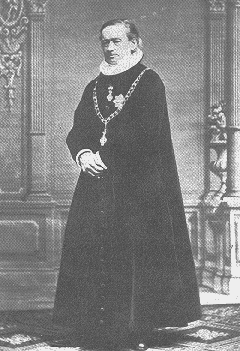
| Bishop Hans Lassen Martensen (1808-1884) in the episcopal vestments that were an abomination to Kierkegaard. |
Mynster, for his part, did not care for Kierkegaard and kept him at arm's length, rightly seeing him as a dangerous rebel. But in spite of the latent conflict between the two, Kierkegaard continued to show deep respect for Mynster while the bishop lived. He thought that he owed this to his father's memory.
But in 1854 Mynster died and was succeeded by Martensen, a man of some standing: his Christian Dogmatics enjoyed a European reputation, and he had made studies of Christian mysticism, exemplified especially in Jacob Böhme, who had opened up new vistas. But he, too, was an orthodox Hegelian, having the self-assumed task of confuting the subjectivity of Romantic morals through a "theoretical knowledge of objectivity, of the absolute form of the State and religion, of science and art." Thus his theological writing became markedly speculative in its character, culminating in the dogmatics which systematized the Christian world of ideas down to the order of precedence among the angels.
For this man Kierkegaard could have no sympathy at all; and when, in his memorial sermon on Bishop Mynster, he went so far as to call him "a witness to the truth", thereby promoting the admired and idolized Mynster, in a way, to the ranks of the martyrs, Kierkegaard could contain himself no longer. This struck him as blasphemy, and as a distortion of every Christian value. There had to be a protest now!
It was the starting point of the final phase of his authorship, in which Kierkegaard abandoned his pseudonymity and in a series of pamphlets addressed the general public direct, in order to open its eyes to the falsification of Christianity that was being carried out by the clergy in Christianity's name. The attacks culminated in the publication of the little journal called Øjeblikket (The Instant), which appeared in nine issues. The tenth was ready for publication when he collapsed in the street and had to be taken to hospital, where he died shortly afterwards, shattered by the great internal strain imposed by his recent activities.
|
|
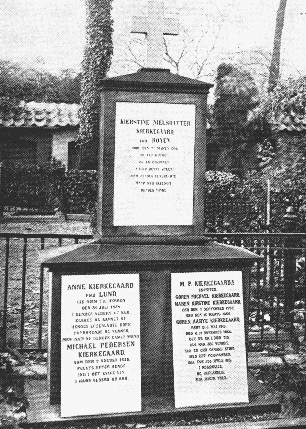
Kierkegaards grave at Assistents Churchyard with the inscription according to his express wish:
A little time and I have won. |
The last years of his life thus marked an intense outburst of production, in which his work to some extent acquired a new content, and to a great extent a new form. In his desire to find an audience he abandoned his former exclusive form to become broad, popular, even demagogic, his style coming to resemble the journalism he had despised.
As regards content, the last publications added nothing new, but they were new in that it was Kierkegaard himself who spoke, and not his pseudonyms.
This is bound up with the aim he had set himself. He spoke in his own name, not in order to rebuke the Church and the clergy for not fulfilling the strict demands of Christianity (for he was well aware that neither they nor he could do that), but because, while they failed, they refused to admit that they neither could nor would conform to the demands, preferring to live in domestic comfort and prosperity and worldly culture, while trying to make themselves and the world believe that this was the meaning of Christianity.