
Background
|
|
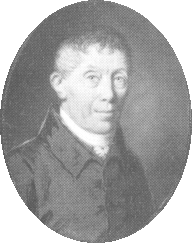
Søren Kierkegaards father, Michael Pedersen Kierkegaard (1756-1838)
|
SØREN KIERKEGAARD was born in Copenhagen on the 5th of May 1813. Both on his father's and his mother's side he was of Jutlandish descent. His father came from a poor moorland farm in a small village in West Jutland, about 10 miles from Ringkøbing. As a boy he was made to watch the sheep on the heath and suffered cold and hardship. But at the age of 12 years he was sent to Copenhagen to live with a maternal uncle who was a prosperous tradesman. Here he received an education and established himself in his 24th year. He made his way with astonishing rapidity and was able to retire from business at the age of 40 and spend the rest of his life as a wealthy man of leisure. He did not die until he had reached his 82nd year, in 1838. At that time his son Søren was 25 years old.
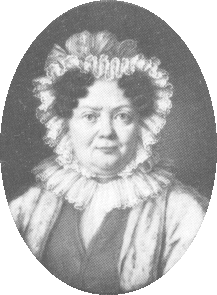
His mother, too, came from a Jutland moorland region, where her father was a smallholder. She was the senior Kierkegaard's second wife and mother of all his seven children. She first came to the house as a servant girl, but married her husband not much more than a year after the death of his first wife. While Søren Kierkegaard, time and time again, makes mention of his father, who was the overwhelming influence in his life, he speaks of his mother hardly at all. She has been described by other people as a kind, cheerful, motherly woman. It would seem that the lighter side of Søren Kierkegaard's nature was inherited from her. She died in 1834, when Søren was 21.
|
|
Kierkegaards mother, Anne Lund. (1768-1834) |
There is no doubt that it was from his father that Søren Kierkegaard inherited the deepest layers of his personality, the periodic depressions that weighed him down, as well as the outstanding powers of thought, both the penetrating dialectic intelligence and the passionate imagination. In 'The Viewpoint of My Authorship' Kierkegaard writes in a purely biographical vein:
"As a child I was strictly and earnestly brought up to Christianity, humanly speaking, insanely brought up: even in my earliest childhood I had been overstrained by impressions which were laid upon me by the melancholy old man who was himself oppressed by them -- a child, insanely travestied as a melancholy old man."
Elsewhere is written: "I owe everything to my father from the very start. When he, melancholy as he was, saw me looking sad, he would say, 'See that you duly love Jesus Christ.'"
It was particularly the suffering Christ that the father presented to the child. His son says that from boyhood upwards he was brought up to the view that the truth must suffer and be derided and scorned. He mentions as well the indignation he had felt from childhood because, long before he had experienced it himself, he had learned that the world was ruled by lies, meanness and injustice. "Even as a small child I was told, as solemnly as possible: that everyone spat at Christ (who, indeed, was the truth), that the multitude (those who passed by) spat at him and said: 'Shame on you.' I have kept this deep in my heart. This thought is my life." So it was. The picture of Christ which his father impressed on the boy's mind remained with him throughout his life as the dominating experience. In several places Kierkegaard wrote that the overwhelming impression of Christ made in his childhood 'humanly speaking' made him intensely miserable. "It was all connected with the relationship with my father, the person I have loved most -- and what does that mean? It means thzt he is just the person who makes one miserable -- but out of love. His fault lay not in lack of love, but in confusing an old man with a child." But 'religiously speaking' in the long run he was grateful to his father."From him I learnt what paternal affection means, and thus I was given the concept of divine paternal love, the only thing in life which is firm and unshakable, the true Archimedean point."
In 1830 at the age of 17, Søren Kierkegaard passed his matriculation examination with flying colours and began at once to read theology. Very little is known about his first years as a. student, but from about 1834 begin the first of his youthful notes that have been preserved. They show that he was reading very widely in the spheres of theology, philosophy and aesthetics. He was particularly interested in German theology, in German idealistic philosophy and romantic aesthetic literature.
|
In summers of 1834 and 1835 Søren Kierkegaard was in
a state of violent mental unrest and ferment. For a time he
was obliged to break off his studies entirely and retire to
Gilleleje, a coastal resort. There he attempted to clarify his thoughts
and among other things wrote in his notes:
"What I really need is to come to terms with myself about
what I am to do, not about what I am to know, except insomuch
as knowledge must precede every act. It is a matter of
understanding my destiny, of seeing what the Divinity actually
wants me to do; what counts is to find a truth, which
is true for me, to find that idea for which I will live and
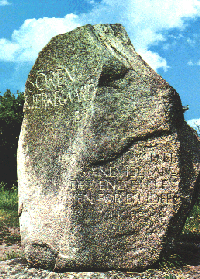
die." When a memorial stone was erected on Gilbjerg Head at Gilleleje in 1935 to commemorate the centenary of the intellectual emergence of the young Kierkegaard, these words from his notebook were inscribed on the stone: "What is truth but to live for an idea." |