
Regine - or Authorship
Then she said to me: Forgive me for what I have done to you. I answered: It was I, after all, who should ask that. She said: Promise to think of me. I did so. She said: Kiss me. I did -- but without passion. Merciful God!
(Søren Kierkegaard)
|
September 8 I left home determined to resolve the whole thing. We met on the street outside their house. She said that there was no one at home. I was rash enough to take this as the invitation I needed. I went in with her. there we stood, the two of us, alone in the parlor. She was somewhat restless. I asked her to play the piano for me as she usually did. She does so, but it does not interest me. I suddenly take the music book, shut it not without a certain vehemence, throw it on the piano, and say: O, what do I care about music, it is you I seek, for two years I have been seeking you. She was silent.
... If I had not been a penitent, if I had not had my vita ante acta, if I had not had my depression --- mariage to her would have made me happier than I had ever dreamed of becoming. But being the person I unfortunately am, I must say that I could become happier in my unhappiness without her than with her --- she had touched me deeply, and I willingly, or even more than willingly, would have done everything.
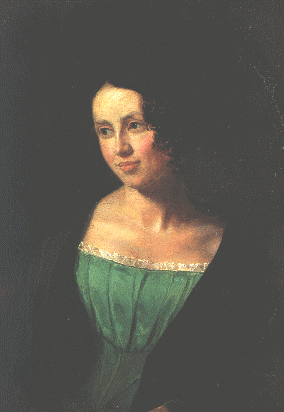
Regine Olsen painted by E. Bærentzen |
Kierkegaard realized, in short, that he could not overcome his melancholy, and he felt unable to confide in the girl what he believed to be its causes. The figure of his father barred the way; and the tragedy of the family curse was a thing that could not be revealed. He was thrown back upon himself and his solitude, and was incapable of "realizing the universal" -- that is to say, incapable of human relationships, of opening his mind to others, or even of taking Church office, as he had often intended but never did.
Two months later he had made up his mind that he would not be justified in attaching this light-hearted girl to himself, and perhaps making her unhappy by his melancholy. Yet a broken engagement was in those days a serious matter, which could reflect unfavourably on the woman in particular. To save Regine, Kierkegaard therefore decided to take all the blame on himself, and in such a way that it would be clear to everyone that it was she who had broken off the engagement, and could hardly do otherwise. So for several months he played the part of an irresponsible philanderer, noisily showing off in public and seeking by every means to turn appearances against himself.
|
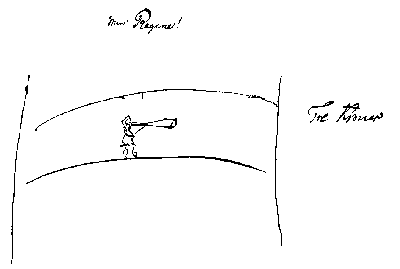
| The only drawing known from Kierkegaards hand. It is from a letter to Regine, written during the initial period of the engagement. "The person with the telescope is me", Kierkegaard wrote. Looking for his fiancee. |
In this he succeeded, except in the eyes of Regine, who saw through him and refused to accept the breach. The affair thus became doubly distressing for both of them. When the break was a fact, Kierkegaard wrote in his journals: "When the bond broke, my feeling was: Either you plunge into wild dissipation, or absolute religiosity -- of a sort different from the parson's melange."
He chose the latter. But at the same time he chose something else: he chose authorship. It was in November 1841 that he broke definitively with Regine. Two weeks later he travelled to Berlin (the only place abroad that he ever saw, and that he visited three times), so as to escape from the scene of these agonizing experiences. And there he began to write. It came over him like a torrent, driving him ceaselessly on during the next ten years -- the most concentrated period of output ever displayed by a Danish author, and surely one of the most compact in world literature.