
Writer and Thinker - I
|
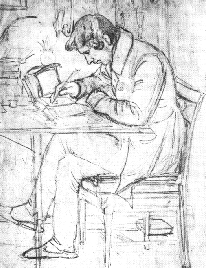
| Drawing by David Jacobsen: Kierkegaard as a student. |
The year of his real debut was 1843. Before that he had written only a few occasional pamphlets and his University thesis, On the Concept of Irony, with Constant Reference to Socrates (Om Begrebet Ironi med stadigt Hensyn til Sokrates; 1841). Now, in 1843, he published no fewer than six books, of which the first is the longest he ever wrote. It is significantly entitled Either/Or (Enten-Eller); and it leads us straight into the world of Kierkegaard's thought. An "either/or" confronts us with a choice, and it is Kierkegaard's meaning to force the reader into making a decision. He must decide how he wants to live out his life, instead of simply drifting passively down the river of life. So in Either/Or Kierkegaard sets out two ways of life, which he calls the "aesthetic" and the "ethical". To "aesthetic", however, he gives a different meaning from the one that we usually give to it; he means the immediate and sensory that is every man's starting point in life. In the first part of his work he shows us a variety of aesthetic lives and types, from the lowest, which is sensory and nothing but sensory, as exemplified in the figure of Don Juan, to the man who has realized the emptiness of a purely aesthetic life, yet who nevertheless clings desperately to it, well knowing that it can lead only to despair.
But why does a life on the aesthetic plane lead only to despair? Because, in Kierkegaard's opinion, man has within him something else, which will not be satisfied by a sensory life. This something else is the eternal. Man, he believes, is made up of diverse and opposing parts. He is, he says, a synthesis of body and spirit, of temporal and eternal, of finite and infinite, of necessity and freedom. It is characteristic of the aesthetic, however, that it overemphasizes one side of the synthesis: the corporeal, the temporal, the finite, and the necessary. Yet the other side is none the less there; and it continually makes itself felt by an anxiety, "a sympathetic antipathy and an antipathetic sympathy", which alarms and attracts at the same time. The term which best describes this call of the spirit in the sensory world, Kierkegaard finds, is "dread" (angst). Thus dread is an indication that man has the eternal within him. Without the eternal there would be no dread. But the man who has felt the dread within, and who yet obstinately persists in an existence in the sensory sphere will end in despair. On these twin concepts, of dread and despair, Kierkegaard wrote two of his most inspired books: The Concept of Dread (Begrebet Angest; 1844) and The Sickness unto Death (Sygdommen til Døden; 1849). These two books are psychological essays, but in Either/Or the same themes are treated in situations of imaginative literature, from the introductory Diapsalmata (aphorisms), in which the alternating moods of the aesthetic man find expression, through examples taken from literature, such as Don Juan, Antigone, and characters from the plays of Scribe, to invented figures like "the unhappiest" and John the Seducer. Together they form a gallery of characters ranging from the immediately sensory, who in a sense is innocent just because of his immediacy, because, in other words, he does not reflect very much on what he does, to the reflecting seducer, who has thought everything out and really acts in defiance and despair.
|
| Young Kierkegaard, about 1836. Artist unknown. The portrait approved by Kierkegaards brother, bishop P.C. Kierkegaard. |
But the man who through the call of despair has felt the inadequacy of a life in the aesthetic sphere, and who does not, in defiance and despair, remain in it, is mature enough to choose something else and enter into the ethical sphere. This is indicated by the fact that the eternal has asserted its claims on the man, who not only accepts it but believes in the possibility of realizing the ethical claims in the temporal, in the sensory world. Such a man is the ethicist who writes long letters to a friend who is an aestheticist, in the second part of Either/Or. The ethicist is a fighter and an optimist, who feels that he is fighting for a good cause and has no doubt that he will have the strength to convince his friends and the whole world what is the good. He will not deny life in the aesthetic sphere, but feels sure that it is possible to unite the two points of view in a kind of synthesis. Not without reason, one of the chapters in the second part of Either/Or is confidently headed: "On the balance between the aesthetic and the ethical in the development of personality".
That, no doubt, is what Kierkegaard himself felt at that time. Having been strongly attracted to the aesthetic in its more refined forms, he doubtless still hoped that it would be possible to find some kind of synthesis between the two worlds. It is true that he himself had abdicated, having renounced Regine and thus the possibility of his ever marrying. But he had neither abandoned his connection with the world altogether, nor the hope that all in one way or another would be for the best.
He was unexpectedly confirmed in this hope one Sunday in the spring of 1843, when, leaving Vor Frue Church in Copenhagen, he chanced to meet Regine, who also came out from church. She nodded to him. That was all; but he was intensely moved. So she was not ill disposed to him; and she did not consider him a cheat! All manner of ideas began to revolve in Kierkegaard's brain, suggesting that perhaps they could come together in some form of spiritual marriage, unsullied by the lusts of the flesh.
But at first he avoided any contact and went off again to Berlin in order to work undisturbed. There he wrote two books, Fear and Trembling (Frygt og Bæven) and The Repetition (Gentagelsen). Both are in the form, so characteristic of him, which lies mid-way between imaginative literature and philosophy, and in which the ideas he is grappling with are presented in clear essence. The idea he is chiefly concerned with in both is faith, though in very different ways.