
Writer and Thinker - II
|
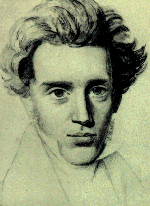
| Perhaps the most famous and certainly the most flattering portrait of Søren Kierkegaard. Drawing by his cousin Niels Christian Kierkegaard. |
In Fear and Trembling he again considers the relationship with Regine: a relationship which obsesses him because of an understandable sense of guilt. The chief protagonist in this short book is Abraham, who was ready to sacrifice his own child at God's command. Kierkegaard's father had sacrificed his child -- or at any rate its happiness -- for God in the same way; and he had been ready to sacrifice Regine for the same reason. In his own case, it had meant that he had sacrificed what was most precious to him in this world; he had renounced.
But Abraham had been restrained at the last moment, and after he had shown absolute obedience to God had been given back his child. And applying this experience to his own personal case, Kierkegaard realized the connection: if Abraham had his son returned to him, while he had to renounce his relations with Regine, it was because Abraham had understood the deepest meaning of absolute obedience to the absolute. That is what we call faith; and in faith lies the conviction that for God all things are possible. It follows that the man who has faith does not need to renounce. The man who renounces proves in doing so that he lacks faith; or, as Kierkegaard says in the entry in the journals dated May 1843, that is to say, at the time he was working on Fear and Trembling: "If I had had faith I should have kept to Regine." And he adds: "Faith, therefore, has hope of this life as well, but only by virtue of the absurd, not because of human reason; otherwise it would be mere worldly wisdom, not faith." In fact, he now sees that at the time when he believed a marriage to be impossible and renounced it he should have had faith, when he would have been filled with the conviction that for God all things are possible, even, against all reason, the ability to make an impossible marriage possible; and in that belief he should have remained true to Regine. This idea he sets down philosophically in what he terms "the double movement of infinity", which consists in first breaking with finiteness but being then enabled, through religion, to recover it. Thus it is possible to make life in this world compatible with life in God after all. Renunciation brings man into a negative relationship with the world, but faith brings him back into a positive relationship with it.
|
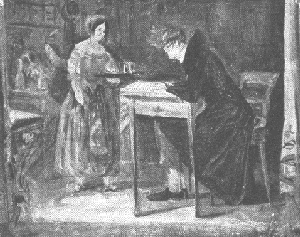
| Caricature by Zeuthen 1843. Kierkegaard at Café reading the newspaper. |
This whole chain of reasoning can be said to have been suggested by the nod which Regine allowed herself when she happened to meet her former fiance one Sunday morning as they were both leaving church. The consequence, as he saw it, was the renewed possibility of achieving a marriage, in one way or another, and in one form or another; a consequence, be it noted, of the absurd, by which he means by virtue of a logic outside the reach of human comprehension and therefore, to human eyes, absurd or paradoxical.
The paradoxical aspect of religion may also entail that religion, in certain situations, can conflict with ethical demands and so appear immoral. God's commandment to Abraham to sacrifice Isaac was requiring him to act like a murderer; and when Kierkegaard was obliged to break with Regine this was contrary to the ordinary view of ethics. These are the problems Kierkegaard discusses in Fear and Trembling, in the chapter which carries the rather involved heading: "Is there a teleological suspension of the ethical; that is to say, are there situations in which a man can be forced to disregard ethical demands for a higher authority?" Kierkegaard answers this question in the affirmative; and it is in just this that the paradoxical character of religion is made plain, since it can lead to demands which, from the point of view of ordinary ethics, are unethical.
|
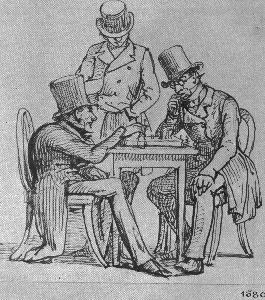
| Chessplayers. Drawing by Wilhelm Marstrand. The player at left presumably Kierkegaard. |
We should remember, however, that it is a question of a suspension, not an abolition of the ethical, and suspension is temporary. So he says: "What is suspended is not lost, but is preserved in the higher function that is its telos, its purpose." The ethical thus asserts itself as the basis of human life, lifting it out of the aesthetic sphere and bringing it into harmony with the claims of the universal, which in turn are a reflection of the religious claims.
But then comes the question of why some people are placed in such a situation by God that they have to act in a way which must bring them -- if only temporarily -- into conflict with ethics. And who are they? They are the people who, whether by a judgment of God or by guilt, have got outside the universal, the ethical. That guilt puts a man outside the ethical is selfevident, guilt being by definition a breach with the universal or ethical. The judgment of God is another matter, for it signifies that there are men whom God has chosen for a special mission, and who cannot, therefore, be measured by the same yardstick as others.
The man who puts himself by guilt outside the universal -- as indeed all men do -- can bring himself back within the claims of ethics only by virtue of the absurd; in other words, by the faith that for God all things are possible. But he cannot achieve this without first learning to renounce. For, rightly considered, guilt consists in clinging to this world and setting it above the kingdom of God; that is to say, by committing oneself absolutely to the relative and relatively to the absolute. Hence it is an essential requirement that one should first learn to renounce and be willing to abjure the things of this world; and then, since for God nothing is impossible, it is possible that by virtue of faith in God's omnipotence, which can accomplish what to the human mind is impossible and therefore absurd, one will recover a positive relationship to this world. Faith in the absurd, in other words, is the same as the double movement of infinity.