
Writer and Thinker - III
The Repetition is in every sense an extension of Fear and Trembling. The concept of repetition is, of course, nothing else but the double movement of infinity, by virtue of which one repeats, or recovers, the world, after first making the negative movement of renunciation. Yet the two books are not alike. The Repetition treats faith psychologically. It is, as its sub-title says, "an essay in experimental psychology". As so often in Kierkegaard, we see things through the eyes of an observer, and this observer is a man interested in the problems but not personally involved: a cool, rather ironic, occasionally somewhat cynical philosopher o f life who is uncommitted to religion, let alone Christianity.
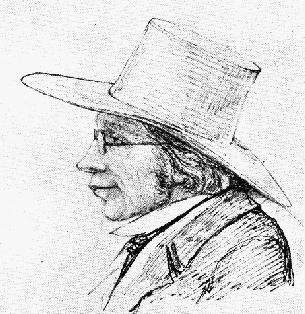
|
| One of the more authentic portraits of Søren Kierkegaard is this drawing made i 1853. The artist was the lithographer H.P. Hansen, who is thought to have observed his subject from his window, which Kierkegaard passed daily on his walk through the city. |
Such a man is the pseudonymous character, Constantine Constantius, who tells the story. The young man who experiences a love affair resembles Kierkegaard to a hair. And the love affair resembles, to a hair, the one that he suffered. The book's present form is not, however, the original one, and we do not know for certain how the first version ended. From a few hints in the journals we may conjecture that it ended with the suicide of the young man in love, probably because he felt unable to honour the claims of a relationship initiated by himself. Thus where Kierkegaard broke off and went away, his alter ego committed suicide. These are two different ways of solving the conflict: the conflict which consists in neither person being capable of making the double movement of infinity.
In its present form, however, the book has quite another end- ing, and for a good reason, one which is connected with Kierkegaard's own experience. We must remember that the new phase in his production had been set in motion by the little en- counter outside the church, when Regine had nodded to him, filling his mind with ideas which both alarmed him and made him deepen his concept of faith and visualize it in the double movement of infinity, while maintaining its intangibility in the form of paradox. When can a smile and a nod have had so many consequences?
But returning to Copenhagen from Berlin, with two manuscripts ready for the press, Kierkegaard was staggered to learn that Regine had become engaged. She was engaged to the young man, Fritz Schlegel, who had been paying her his attentions before Kierkegaard had come into her life, and with whom she had become reconciled. To Kierkegaard this meant that all he had envisaged after that fateful nod, all the dreams he had dreamt of some spiritual marriage between them, or at least mutual loyalty, married or unmarried, and the whole system of thought which had crystallized like a pearl in the mussel-shell of the smile had proved vain and futile. His world seemed to crumble and turn to dust at his feet. He would make a laughing-stock of himself if he were now to publish his new book, in which the hero commits suicide from disappointed love -- because his own loved one had become engaged to another, as the ending of The Repetition would of course be maliciously misinterpreted. He promptly tore up the last seven or eight pages of his manuscript (it may even have been set up in type) and at top speed wrote a new conclusion, in which we learn that the girl has married another, and in which the hero, instead of taking his life, triumphantly exclaims:
"I am myself again; here I have the repetition; I understand all, and life seems finer to me now than ever... I am myself again; the machinery has been started up. Cut are the meshes I was ensnared in; broken is the spell that had bewitched me, so that I could not return to myself... It is over; my skiff is afloat. The next minute I shall be back to where my soul hankered, where ideas surge with elemental fury... where a man ventures his life every mo- ment, every moment loses it and regains it. I belong to the idea. When it beckons me, I follow it and when it makes an appointment I wait days and nights; there none calls me to dinner, there none waits with supper. When the idea calls I leave everything; or rather, I have nothing to leave; I betray no-one, I grieve noone by being true; my spirit is not grieved by having to grieve another. When I return home, no-one reads in my look; noone questions my appearance; no-one demands of my manner an explanation, which I cannot even give anyone, of whether I am blissfully happy or deep in misery, whether I have gained life or lost it. The cup of intoxication is handed back to me again. Already I breathe in its fragrance; already I sense its effervescent music. But first a libation for her who saved my soul, which lay in the solitude of despair: praise be to womanly magnanimity! Long live the flight of thought; long live danger in the service of the idea; long live the hardship of combat; long live the jubilation of victory; longe live the dance in the whirl of the infinite; long live the wave that hides me in the abyss; long live the wave that hurls me up above the stars."
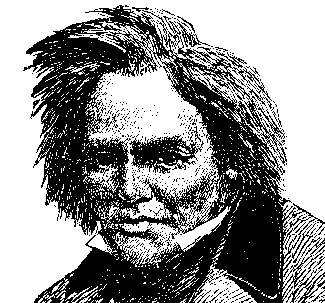
|
| This drawing of Kierkegaard was published in the Journal "Ugens Nyheder" October 11, 1889. It was told that the anonymous artist had known Kierkegaard for many years. |
This ecstatic outburst which Kierkegaard substitutes for the tragic ending was meant as his reply to criticism. He would be no ludicrous, piti ful fool. On the other hand, the world might gain the impression, if it liked, that Regine's engagement came as a relief to him. The reality, his true reactions to the news, can be gleaned from his journals, where, after first hearing the news, he fumes with rage and scorn for the girl who had once cried "It will be my death," and who yet, two years later, lived happily on, in the arms of another man.
Nevertheless in the young man's ecstatic outburst there is more truth, more of Kierkegaard's own inmost being, than he was aware of when he set down these words. For what the young man says, that he can now feel free of all human interests and can therefore devote himself unreservedly to the idea, i.e., to his philosophical and artistic work: that was precisely the impulse which, deepest down, forced the break with Regine, as he was later to realize. The break and its final consummation in Regine's engagement, shattering every dream of a marriage of the spirit, had floated his skiff; except that it was no skiff, but a mighty liner, which now headed, under full sail, for the ocean of philosophy and literature.
The next few years, indeed, were to witness his most intense period of production and the most brilliant successes of his creative art.