
Writer and Thinker - IV
Fear and Trembling and The Repetition appeared together in October 1843. In the same way, in June 1844, with only four days between them, Kierkegaard published the two books Philosophical Scraps; or a Scrap of Philosophy (Filosofiske Smuler eller en Smule Filosofi), "by Johannes Climacus, edited by S. Kierkegaard", and The Concept of Dread, "a simple psychological-demonstrative reflection regarding the dogmatic problem of original sin, by Vigilius Haufniensis".
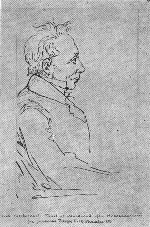
|
| The painter Wilhelm Marstrand made many sketches of Kierkegaard in the early 1870th, about 15 years after Kierkegaards death. |
The many pseudonyms can seem like an affectation but indicate a deliberate strategy, by which Kierkegaard aims to avoid teaching or preaching; nor can the opinions expressed in his books always be definitely ascribed to him. When a work like Philosophical Scraps is described as "edited by S. Kierkegaard", we may be sure that it is to a special degree an expression of his own thoughts; but only in those cases where he is shown, not as editor, but as author of the work in question, can the opinions in it be ascribed to him with certainty. This applies, on the whole, only to the many collections of sermons which he published between the literary and philosophical works.
Philosophical Scraps is an attempt to elucidate Christianity. It is, in other words, a work of dogmatics, though, to be sure, a work of an altogether undogmatic character. Perhaps it would be more correct to say that it is an attempt to present Christianity as it should be if it is to have any meaning. Here Kierkegaard's ideas on the paradox as adumbrated in Fear and Trembling come to full flower, because Christ's incarnation is itself a paradox; partly because it means the appearance of the infinite in time, which no human mind can compass, and partly because God, as guiltless, must be absolutely different from man, whose destiny lies in falsehood, since he lives in sin.
The Concept of Dread is concerned with sexuality, taken as the constituent element in the concept of original sin. This extraordinarily penetrating work, perhaps the first work of depth-psychology in existence, is based on the previously mentioned concept of man as a synthesis of soul and body, temporal and eternal, freedom and necessity; and dread is the feeling which grips and dominates the man whose synthesis is threatened by the fact that one aspect of it -- the body, the temporal and the necessary -- is gaining control. Dread is thus a warning voice, though it can be, as well, a temptation to new sin; for, as Kierkegaard says, in words which anticipate Freud's view in Das Ich und das Es, and in Uber das Schuldgefiihl, "Man is not conscious of guilt because he sins, but sins because he is conscious of guilt."
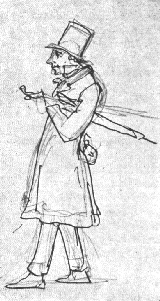
|
| Drawing by Wilhelm Marstrand. |
The man who, through the voice of dread, has realized the inadequacy of the aesthetic, sensory sphere has reached the maturity to choose something else and enter the ethical sphere. This is marked by the assertion of its claims by the eternal. But as was the case in the aesthetic sphere, so in the ethical: we rnust distinguish between different stages. At its lowest stage man still believes that he can, alone, meet the requirements of eternity in the world of time. At its highest stage, the ethical man has discovered how little he can achieve by his own endeavours. The man who has realized this has become mature enough to cross from the ethical to the religious sphere, which is based on this very recognition of the inadequacy of human endeavour.
This idea, which had been implicit in all the previous publications from Either/Or onward, dominates the next major work, Stages on Life's Way (Stadier paa Livets Vej; 1845), a voluminous book that is perhaps Kierkegaard's maturest artistic achievement. In a way it reiterates the idea of Either/Or, just as the title is a variation on that of the debut book; but with the vital difference that in the new work the religious stage, as a logical consequence of the ideas embodied in the former works exposing the impotence of human ethics, is separated into a special stage.
Stages on Life's Way, a work of art, and perhaps the maturist expression of Kierkegaard's ideas, is a major work in Danish literature. Before seeing it through the press, however, he was already at work on yet another great book, this time a work of philosophy, and nothing less than a reckoning with the predominant contemporary school of philosophy, Hegelianism, which he feared and opposed with all his energy, because it represented a backward step towards paganism and saw the whole development of the world as a manifestation of a necessary logical -- or as they said then, dialectical -- process, with Christianity an inferior part. Had Hegel's system been anti-Christian it would not have given such great offence to Kierkegaard; but just because it accepted Christianity and incorporated it in the system it was dangerous, and in the great work with the singular title oncluding Unscientific Postscript to the Philosophical Scraps (Afsluttende uvidenskabeligt Efterskrift til de filosofiske Smuler), of 1846, he settles accounts with Hegel's doctrine or system. It is probably the wittiest philosophical work ever written.
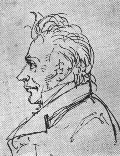
|
| Drawing by Wilhelm Marstrand. |
In the first place, Kierkegaard attacks Hegel's tendency to systematize the whole of existence, declaring that a system of existence cannot be constructed since existence is incomplete and constantly developing. Likewise, he attacks Hegel's confusion of two things which are entirely unconnected: namely, logic and existence. Hegel had endeavoured to introduce mobility into logic; Kierkegaard demonstrates the mistake of trying to mix the categories into a single hotch-potch. Hegel thought he had created the objective theory of knowledge; Kierkegaard, sharply opposing this, put forward the thesis that subjectivity is truth, or -- to quote his own definition of what is truth -- "the objective uncertainty, maintained possession of the most passionate fervour, is the truth, the highest truth, for one existing". To which he adds: "But the given definition of truth is a paraphrase of faith". Kierkegaard deduces one further consequence of his definition of truth: "When subjectivity, intense fervour (inderlighed), is the truth, then truth objectively fixed is paradox."
The threads are thus brought together in this, the most systematic work of the great system-hater. It is certainly no system; but those who have the jaws to bite on this vast work, and the teeth to crush its tough nuts, will there find Kierkegaard's ideas in their most consistent and coherent form.