
The Clash with the World
The pseudonymous authorship caused a great sensation
among the literati of the time in Copenhagen. In literary
circles it was well-known who the author was, although
Kierkegaard guarded his pseudonymity jealously until 1846.
In the autumn of 1845, a few months before the publication
of the Unscientific Postscript, the talented critic P. L. Møller
wrote a review of the existing pseudonymous works. This
gave rise to a quarrel, the so-called 'Corsair dispute', which
in many ways left a deep mark on the last ten years of
Kierkegaard's short life.
P. L. Møller's review contained much praise and admiration,
particularly for Kierkegaard's description of the aesthctic stage.
But the reviewer took a sceptical view of Kierkegaard as an
ethical and religious personality and allowed
himself some remarks of a somewhat impertinent, almost
personal nature. P.L. Møller devoted his attentions mainly
to Guilty? -- Not Guilty? He undoubtedly knew that this
book was a poetical-realistic treatment of the story of Kierkegaard's
own engagement. He writes of the chief male
character, Quidam, that he has lost all that constitutes personality:
sentiment, intelligence, will, decision, action, nervous and muscular
strength. Everything has been sacrificed
to sterile dialectics. And this Quidam has put the female
character to such experimental torture that it is astonishing
that she has not gone mad or drowned herself. Thus it says:
"If healthy human reason may be allowed to step in here,
it might perhaps say in rude impulsiveness: If you wish to
regard life as a dissecting-room and yourself as a corpse, very
well, tear yourself apart as much as you like; so long as you
do no harm to others the police will not come and disturb
your activities. But to weave another person into one's
spider's web, dissect her alive, or torture the soul out of her
little by little in the name of experiment, that is not yet
permissible, except in the case of insects, and is there not
horror even in the thought of that, which is repulsive to
healthy human nature?"
In fact P. L. Møller takes up a moral stand against Kierkegaard
which must have been all the more irritating as
P.L. Møller had a bad reputation for being a loose-living
"aesthete" just in Kierkegaard's understanding of the word,
and as a Don Juan. Kierkegaard immediately wrote a scornful
article, full of remarks calculated to arouse suspicion
about P. L. Møller, in the distinguished daily paper "The
Fatherland". At the end of it he expresses the following de-
sire: "If only I might soon appear in "The Corsair"! It is
really hard for a poor author to be pointed out as the only
figure in Danish literature who has not been abused in it."
"The Corsair" was a small, but very widely circulated and
disreputable weekly which was wont to satirize, often in
a coarse manner, the prominent personalities of the time.
It carried on "a regime of terror", as was said at the time,
and people feared "to be in the Corsair". The magazine had
been started in 1840 by a quite young, promising poet, Meir
Goldschmidt, who still edited it. P.L. Møller was an occasional
contributor. Young Goldschmidt was full of admiration for
Kierkegaard and had on various occasions "immortalized"
Victor Eremita in his paper. Kierkegaard must undoubtedly
have thought that by his officially expressed wish
to be abused in The Corsair he had placed Goldschmidt and
P. L. Møller in an insoluble dilemma. What were they to do?
But Goldschmidt complied with the wish. From January
1846 "The Corsair" embarked on a stultification of Kierkegaard
as an author and as a private individual. The short
articles were often accompanied by malicious caricatures,
and the persecution continued for a long period. The effect
on Kierkegaard was overwhelming, as can be seen from his
numerous statements in the Journals about Goldschmidt and
his "vulgarity", which he also called "literary contemptibility".
Since he was very young, Kierkegaard has been in the
habit of spending much time strolling in the streets, and he
was very fond of holding conversations with ordinary folk.
He was generous to beggars. Now according to his own
statement his relationship with "the man in the street" was
altered. He became known about the city as "a half-crazy
eccentric". Street boys yelled Either -- Or after him and prostitutes
accosted the author of The Diary of a Seducer. It
was an easy matter for "The Corsair"'s illustrator to caricature
Kierkegaard's outward appearance. He was not only
round-shouldered but sway-backed and crook-backed as
well. His legs were remarkably thin and his gait strangely
irregular. Now it became a torture for him to walk along
the street. He gradually began to feel like "a martyr who
was being ridiculed to death." No one came to his aid to
fight against "The Corsair". "The more distinguished envy"
held back.
Kierkegaard began to feel more and more isolated, and
during the following years his relationship with Christianity
grew more intensified. The severe form of Christianity which
he had learnt as a child began to become more and more
dominant. He had experienced the evil of the world per-
sonally through "The Corsair" 's persecution. He begins to
feel more and more of a martyr. His leitmotif becomes to an
increasing degree to "understand himself in suffering". The
Christian ideal is a dying to the world, to temporality. Even
great national events such as the Danish-German war of
1848 -- 50 are indifferent to him. "I know only one danger, that
of religiosity." The liberal constitution of 1849 is also indifferent
to him. He was distinctively conservative in politics, full
of irony towards the democratic principle of coming to the
right choice by means of a majority of votes, of
the ballot system.
To my contemporaries my significance depends on my trousers; it may be that to a later era my significance will also depend a little on my writings.
(Søren Kierkegaard)
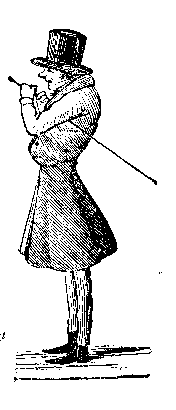
The first of many cartoons of Kierkegaard made by cartoonist Klæstrup appeared in The Corsair January 9, 1846. It depicted Kierkegaard as a man with extremely thin legs and with one trouser-leg invariably shorter than the other.
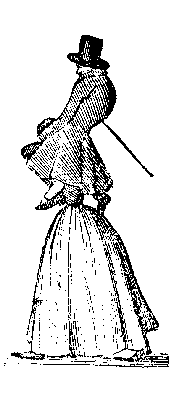
Goldschmidt took a particular delight in having Kierkegaard caricatured in various ludicrous situations. Here training his girl by riding on her back.
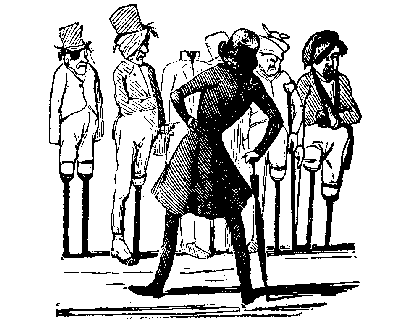
Kierkegaard mustering his rather disabled troops in the combat with the Corsair.
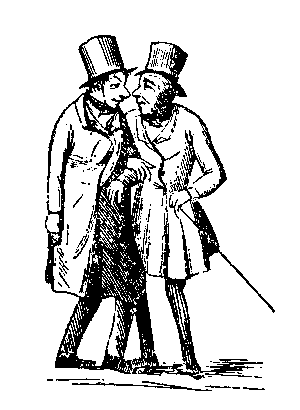
Søren Kierkegaard speaking with P.L. Møller. Cartoon by Klæstrup.